Feeds:
Posts
Comments

Archive for the ‘Contemporary Monasteries’ Category

IMG 870

St. Pachomius receiving instructions from an angel about the great (or angelic) schema for monastics. (This wall-painting is located in a monastery near Yiannitsa, Greece.)

Christ is Risen!

(Source)

By the 4th century, Christian asceticism had taken two forms – the anchoritic or hermitic, and the communal or cenobitic.

From ancient times the Holy Church has sanctified both forms of monasticism as equally valid in terms of their purpose – spiritual perfection. The difference between them lies not in their essence but in the nature of their activities; it is determined by the intentions and abilities of the monk, and, to a certain extent, by external circumstances.

Thus, the name of St. Antony the Great is linked with the isolated hermitic life, the so-called contemplative monasticism. On the other hand, the name of St. Pachomius, an ascetic of the same era (4th century), is associated with the appearance of communal monastic life – so-called cenobitism. It is evident from their lives how miraculously and providentially the two forms of monasticism were organized. The main vow, one that is common to both forms of monasticism, is that of obedience either to a starets (if the monk is leading a hermitic life) or to a hegumen (if he is living in a cenobitic monastery).

“A monk must frankly tell his starets how many steps he takes or how many drops of water he drinks in his cell, lest he thereby commit a sin,” the spiritual fathers told the newly professed.

The Rule of St. Pachomius, which was revealed to him by an angel, defined monasticism in external terms and demonstrated the essence of monastic life. “Do not admit anyone to the performance of higher feats till three years have passed,” the angel said. “Let him enter this domain only when he has accomplished some hard work.”

St. Pachomius began his monastic path as a hermit. However, he saw in cenobitism a form of monasticism which affects more than hermitism a monk’s spiritual life and promotes the perfect development of his soul’s qualities.

According to the Rule of St. Pachomius, the act of acceptance into a monastery had three steps and consisted of (a) “temptation” (trial), (b) clothing, and (c) presentation to the starets for spiritual guidance. Each of the three steps undoubtedly had its own significance. They marked the beginning of the three stages in monasticism which have become deeply embedded in the life of the Eastern Church: first, the novice (or rassophore); the second, the monk (known as a monk of the Lesser Schema); and the third, the monk of the Great Schema (or simply schema-monk).

Read Full Post »

The doors of repentance do Thou open unto me, O Giver of life!

The doors of repentance do Thou open unto me, O Giver of life!

Repentance is the renewal of baptism and is a contract with God for a fresh start in life. Repentance goes shopping for humility and is ever distrustful of bodily comfort. Repentance is critical awareness and a sure watch over oneself. Repentance is the daughter of hope and the refusal of despair. The penitent stands guilty – but undisgraced. Repentance is reconciliation with the Lord by the performance of good deeds which are the opposites of the sins. It is the purification of conscience and the voluntary endurance of affliction.

(St. John Climacus, The Ladder of Divine Ascent, Step 5, Holy Transfiguration Monastery, Boston, 2001)

To hear two wonderful talks on repentance listen to Fr. Joseph of St. Gregory Palamas Monastery on Ancient Faith Radio. Part One is here, and Part Two is here. Thanks to The Dutiful Bee for suggesting them!

Read Full Post »

OLYMPUS DIGITAL CAMERA“It’s this renunciation of the world which is actually the fundamental key to being a Christian, that every Christian has to embrace in one form or another. There’s no Christianity without asceticism. There is no Christianity without self-denial and taking up the cross. Otherwise you have just a parody of Christianity.” -Metropolitan Jonah Paffhausen (May, 2007)

The above is from a great interview with Metropolitan Jonah (at that time Abbot Jonah) on Ancient Faith Radio‘s now archived program Our Life in Christ.

To hear the interview click here.

Read Full Post »

Today is the anniversary of the death of Blessed Fr. Cosmas of Grigoriou Monastery on Mt. Athos. He lived and worked for Christ in Zaire, Africa until his tragic death in 1989. May we have his prayers and blessing!

An excerpt from the Introduction to Apostle to Zaire: The Life and Legacy of Blessed Fr. Cosmas of Grigoriou (Source)

In every generation there are those few exceptional souls who rise out of the conventionality of social life to become pathfinders to the catholicity and otherworldliness of Christianity. Heroic and uncompromising, they imitate Abraham and become exiles and martyrs for Christ, following Him with loving exactness and mountain-moving faith. They “hate their life in this world” in order to keep it—and that of their neighbor’s—for eternity; and to successive generations they become models to imitate, witnessing, long after their departure, to the honour the Father bestows on those who serve Him.

Such a one was blessed Father Cosmas of Grigoriou, enlightener of Zaire.

A Model of Mission Work in this Age of Antichrist

From as early as eighteen years of age [Fr. Cosmas] received from God the call to work in His mission field. Possessed of a dynamic personality that “was inspired by a burning love for Christ, he did not want to live a conventional Christian life nor to be limited to some usual ecclesiastical career and service. He longed to offer himself entirely to God and his fellow man.” He sought not honors, for “his chief concern was with the salvation of men and the upbuilding of Orthodoxy in Zaire.” The beloved Cosmas was, in the words of the former Metropolitan Avgoustinos of Florina, “the trailblazer of a beautiful journey for our race.” He made Christ’s departing directive to “teach all nations” his point of departure from a life of compromise and port of entry for Orthodoxy in the sub-Saharan and the hearts of countless souls. Unlike the missionaries of heterodox confessions, he laid stress on both the first and second part of the Great Commission: “Go ye therefore, and teach all nations, baptizing them in the name of the Father, and of the Son, and of the Holy Spirit; teaching them to observe all things whatsoever I have commanded you.” His success, or rather faithfulness, in carrying out the first half of the Great Commission, was a direct result of his faithfulness and resolute determination to observe the second half, that is, to be exact in teaching them “to observe all things” that Christ has commanded us.

It could not be otherwise, for the African is neither as the contemporary European, worn out by centuries of dizzying ideologies and spent on a myriad of humanistic philosophies, nor as the typical American, quick to compromise and moderate things in order to achieve outward success. His noble, humble soul still inclines toward the other world and his simple, intuitive mind still has a healthy disposition for the noetic realm. A few months before his departure from this life, Father Cosmas visited the monastery of his repentance and spoke to the pilgrims there of this African nobility and their desire for authentic, ascetic Orthodoxy. Bishop Athanasios Yievtich, a close disciple of the great contemporary Church Father, Archimandrite Justin Popovich, was present and relates what Fr. Cosmas had to say:

They are people with a sensitivity and awareness of the inner world. Europeans usually underestimate them, but they are very mistaken. The soul of the African inclines toward mysticism and for this reason Orthodoxy has something to say to them and something to offer, but only authentic Orthodoxy— monastic, hagiorite Orthodoxy. For among the brethren of Africa, witchcraft and magic holds great sway, a real demonocracy. In Africa, I saw how true the Gospel of Christ is! Everything that He said about the possession of men by the demons, I saw first hand. However, the Living and True God is more powerful than Satan and all his servants. Let it be understood, however, that true missionary-apostolic work cannot be carried out in Africa if one does not decide to leave his bones there.”

And so in teaching the native Africans the entire Gospel of Christ and revealing to them the undistorted Image of the God-man and His Church, it was only to be expected that his self-offering would likewise be complete and unqualified. In his “unique, genuine and very useful” study on mission work, entitled Thoughts about Missionary Work from Experience, he lays out the cornerstone principle for all who would follow his example:

The missionary’s beginning is significant, however it is not the sum of the matter . . . The outset might be blessed or might become blessed at the end. What’s important is that the giving be true and total, without holding back, with a disposition to self-sacrifice and self-denial, and with the aim of leaving our bones among the natives . . .”

Fr. Cosmas’ grave. Located in Zaire, Africa.

Long before one leaves his bones on the mission field, however, he must have discarded his pride and vainglory first, if he wants the final offering to be fruitful. Thus, for Fr. Cosmas the true missionary, in order to attain the blessed end, must leave no room for jealousy or vainglory, but rather must understand all to be shared: “common the struggle, common the pain, and common the glory of the Church.” He must “offer an open heart, love and communicate with others, concern himself with his own problems without adding more, being attentive to what others are doing, without turning to the devil and causing division.” And carrying out his duty in humility, “the true missionary does not seek recognition for his work, neither from the natives nor from those abroad, for the testimony of his sound conscience and the witness of his spiritual father and co-workers is sufficient for him.”

About the Book

Apostle to Zaire is the story of the life and legacy of a man who was chosen by God from the young age of 18 to be the Enlightener of Zaire. In the first part of the book, we encounter the life, last days, letters and the writings of Fr. Cosmas–an Athonite ascetic, a modern model of mission, an apostle to the heart of Africa. In part two, we read accounts of miracles and the battle with magic, interventions of the Saints and conversions of sinners, missionary adventures and baptismal testimonies. This a unique biography of a contemporary missionary and a practical introduction to Orthodox mission work.

To read excerpts from the book featuring Fr. Cosmas’ letters, see here.

You can purchase the book through Amazon or from St. Anthony’s Monastery.

Read Full Post »

2012-0426-myrrhbearers1-1

From an interview by Despina Prassas with Mother Raphaela (Abbess of the Holy Myrrhbearers Monastery – Otego, New York)

(Source)

D.: What counsel would you give to a woman contemplating the monastic life?

M.R.: That is a very difficult question, because I have learned that every single woman who comes or is thinking about the life or doesn’t know she is thinking about the life but is brought here for who knows why, is different. And there are no recipes.

I would say the most important thing is simply to work on growing before God, and I use those words very advisedly. It is not just becoming more “pious” in a way that means that a woman comes here woefully unprepared to give her whole life to God: she has her little church life, and the rest of it she doesn’t consider good enough or holy and sacred, and she tries to bring in just that part of herself. But you can’t live twenty four hours a day, seven days a week, fifty two weeks a year with the same women and just bring in a little part of yourself. It doesn’t work. The other parts are always there. I would just try to live as normally as you can before God. The monastic life is living with other people and working hard. I would say try to live as balanced and as whole a life as you can. If you are trying to be somebody other than yourself, if you are trying to deny who you are, you are not going to make a good nun, because a good nun is somebody who is facing the whole of who she is before God, with all of her gifts and all of her limitations.

Some people look at the monastic life and ask themselves how can they possibly squeeze themselves into that small space. But the true monastic vocation is getting rid of the limitations you have placed on yourself and is actually a much broader environment than the world, something that people don’t realize. I think every sister here has had the same experience I did coming into this life – I don’t want to be quite that big, I don’t want to grow that much, I don’t want to be that large. And it is not an escape. We don’t have the escapes that most people have in the world, without even realizing it. If I’ve had it with my sisters, I can’t just hop in the car and go see a movie. I can’t “veg” out in front of the television. We’ve taken solitaire off the computers. We don’t play games here. There are a lot of escapes that we don’t have. We have had women come here who after twenty-four hours just have to leave. They can’t handle it. It is too scary. It takes a physically and mentally healthy woman. We are all slightly neurotic; everyone is. But there has to be a basic health in order to survive here.

So, I think the main thing to say to a woman is to grow just as best as you can, and if you think you’ve got a calling, visit monasteries. It is a lot of work but a lot of fun.


Read Full Post »

hamatoura monastery

Hamatoura Monastery. (Image from: http://www.hamatoura.com/)

Please, bring joy to your heart and others by clicking on and sharing this link. Watch the most beautiful e-card by the fathers of Hamatoura Monastery (the Holy Mountain of the Theotokos) in Lebanon. I wish I could embed the video here. Every year I watch it about 50 times during the Christmas season. There is also the option to hear it in Greek and Arabic – along with many other e-cards – on the monastery’s website (just click on ‘e-cards’ on the right hand side of the website).

Christ is Born! Glorify Him!

Read Full Post »

The bottom half of my icon corner in our Thessaloniki apartment.

(A repeat post from last year.)

On this day, December 20, the Church commemorates the Holy Father among the Saints, Ignatius the God-bearer (1st century).  St. Ignatius was the child who Jesus Christ pulled into the crowd of Apostles as recorded in the Gospel of St. Matthew, Chapter 18.  Our Lord used St. Ignatius as an example of the greatest virtue, humility: “Whosoever therefore shall humble himself as this little child, the same is greatest in the Kingdom of Heaven.”   I will return to speak of St. Ignatius the God-bearer, and humility, but for now I must take you all along with me into a Christmas of the past, five years ago when we lived in the “Orient”, South Korea.

My husband and I had been living there for a few months, teaching English and paying off student loans, when we decided to travel to St. Anthony’s Monastery for Christmas.  My brother and sister-in-law were flying there as well, my mother and younger sister were to travel down from Canada and we were all to spend Christmas in Arizona, in the desert.

We left for America on December 23 and were due to arrive in the afternoon of the same day.  However, once in Los Angelas we found out our flight was cancelled and that we would not arrive at the monastery until the middle of the night, Christmas eve, ie. the vigil would be halfway over.

Instead of handling this as an adult I threw as close to a temper tantrum as any grown woman can, not of course until we were alone in our hotel room.  (My poor husband might have gained a crown in Paradise for that night alone!)  We had traveled for many hours, I was exhausted, sick with the flu, and unbelievably selfish and childish, but not the way St. Ignatius was “childish”, or rather “child-like”.

After crying and being angry for quite some time, I laid down to try to sleep and inside of me I heard a voice say, “The Theotokos accepted God Almighty’s choice to be born in a cave without protesting.”  That killed me.  It cut me to the quick.

How could I have protested against God’s will so much?  How could she, the All Immaculate, Mother of our God, who once dwelt in the Holy of Holies now allow herself, let alone God Incarnate, to enter a cave of common animals?  God chose where He would be born, it was not an accident.  It wasn’t enough that He should become Man, but in order to teach us by example who He is and what humility means He chose to be born in a humble manner, in a dark, cold, and presumably dirty, cave.

Instead of waiting until the next evening to take the rescheduled flight, we went to the bus station in downtown Los Angelas at 12:00 AM, in the middle of the night, to see if we could catch a bus.  The line was huge and it didn’t look like we would get on, but I was by no means going to protest.  Once they filled the bus we were left standing in the bus station, seventh in line. It did not look like we were going to arrive at the monastery until the evening of the next day.

Suddenly, however, they pulled up another bus, they would take two buses to Arizona that night!  We were on our way.  Around six or seven in the morning, I woke up still on the bus to see the most beautiful sight, the sun rising in the desert, the mountains looked like they came out of an icon of the Magi traveling from the East and I thought about my behaviour and the humble acceptance of our All Holy Mother to willingly have her child, God Incarnate, born in a cave with not so much as a single complaint; not even in her thoughts.

I imagine, in fact, that she knew the nature of the Divine so well that she emphatically understood the height of humility Our Lord sought to display by His birth, life, death and resurrection.  That experience humbled me – on my way from the “Orient” to kneel down before the Incarnate Lord, a Man and yet perfect God, to ask Him to dwell in the cave of my heart that is even more lowly and unfit than the cave of common animals in which He dwelt long ago.

And so, I return to St. Ignatius, the humble child, who, because he lived his life in humility and prayer, came to have the very Lord dwell in His heart.  When He was lead to his martyrdom he ceasely repeated the name of Jesus Christ (ie. the Jesus Prayer).  When the soldiers asked him why he did this he responded that the Name was written on his heart and so he professed with his mouth Him who he already carried within.  Therefore once he was devoured by lions the soldiers, remembering what he had said, cut open his heart to see the name “Jesus Christ” written in gold.

Let us therefore become like St. Ignatius and the Virgin Mary by becoming “god-bearers,” little “theotokoses,” through acquiring Christ in the cave of our hearts, in humility and peaceful acceptance of His Divine Will.  Just as the earth once “offered a cave to Him who is Unapproachable” so let us kneel before Him and offer ourselves for His dwelling, He who became for us a Child, that we might unite with Him Who is Pre-eternal God.

Seeing a strange child-birth let us estrange ourselves from the world by transporting our minds to Heaven; to this end the Most High God appeared on earth a lowly man that He might draw to the heights those that cry to Him. -Akathist Hymn, St. Rominas the Melodist

Read Full Post »

monastery“Orthodox monasticism is a life, an intense life, of prayer and asceticism removed from the world. In order that we ourselves grow in a deeper relationship with God. In order to serve our fellowman better. We believe that if we grow spiritually, if we deepen our spiritual relationship with God, if we deny ourselves, then we follow Christ’s example of sacrifice for the world. In this way Orthodox monastics sacrifice themselves for the whole world.

“What makes a good monastic is one who can bear in one’s heart the joys and sorrows of the world. Is one who has reached that level of identifying with the pain and suffering of the world, with the needs of every Christian who lives in the world. And because monastic communities are somewhat removed from the world, from the noise of the world, from the activities of the everyday world, then it provides a place also for pilgrims to come and find rest and peace, a word of counsel and of comfort.”

-Mother Gabriella, Abbess of the Holy Monastery of the Dormition of the Mother of God (Rives Junction, Michigan)

I transcribed the above from an interview, Life in a Monastery, with Mother Gabriella on Ancient Faith Radio from 2006. The whole interview is great but I found the above passage too special not to share.

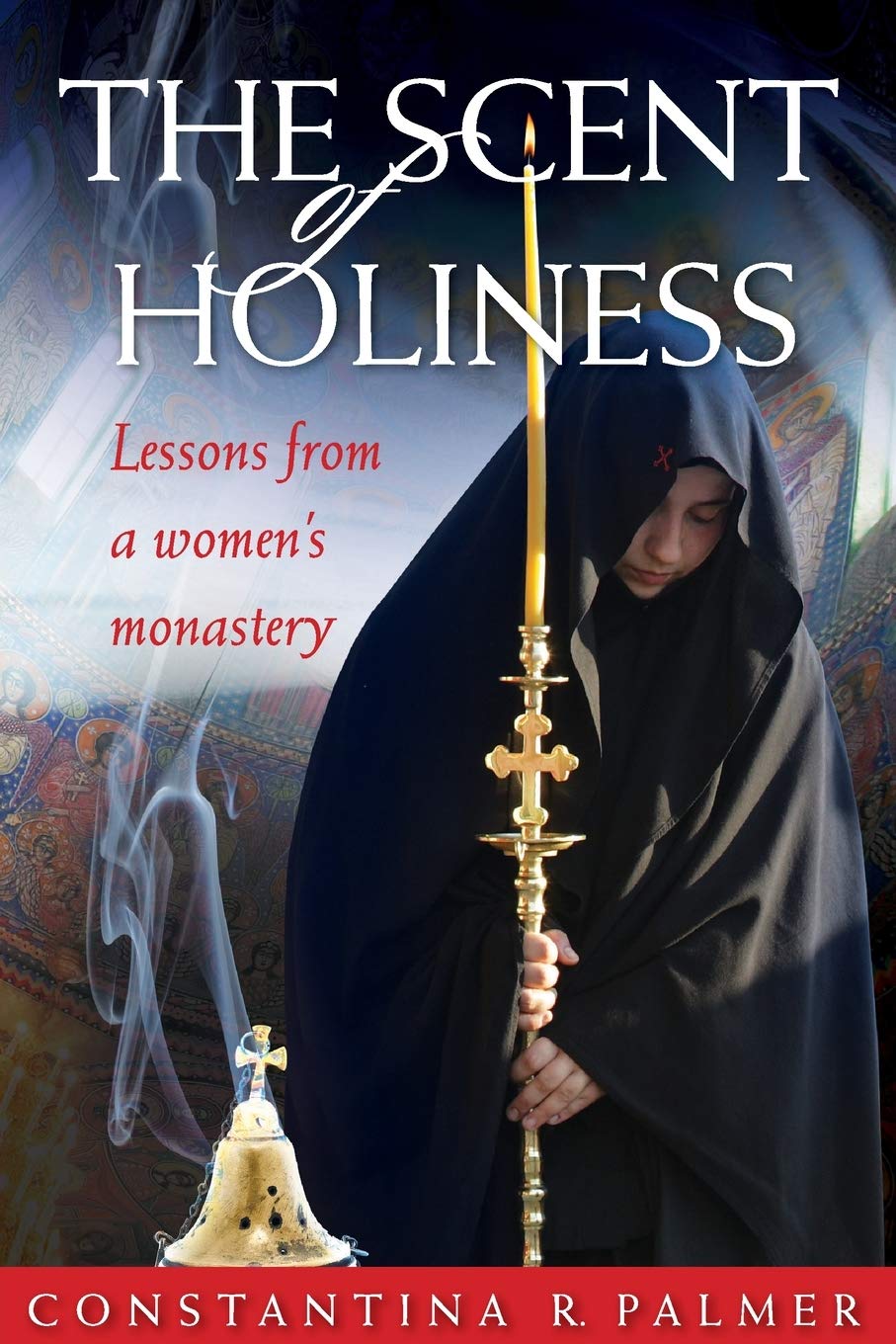
For those who don’t know Mother Gabriella wrote the beautiful foreword for my book The Scent of Holiness. I had the great blessing of meeting her here in Greece (in 2009) and we’ve kept in contact since then. I’m honoured that she wrote such a wonderful foreword!

On a somewhat unrelated note: although I had plane tickets to leave Greece and return to Canada today (for good) due to some unforeseen (though entirely not surprising) circumstances I will be here for another two and a half months. So please keep us in your prayers!stylized peacock

Read Full Post »

Introduction to the Monastic Life

In her first talk, Mother Magdalena talks about the purpose of monasticism, the everyday life of a monastic, and the process of becoming a monastic.

Prayer as a Way of Life, a Relationship

Understanding the concept of relationship. What is prayer? Why do we need God? What’s the place of the church, the body of Christ? Why does God need us? Why do we want God (different from needing Him)? What’s the difference between heaven and hell?

Prayer as a Means to Make Christ the Center of our Life at All Times

Mother Magdalena talks about 3 forms of prayer: 1. Communal/Liturgical prayer. 2. Personal prayer time. 3. Continual prayer.

Godly Self-Care, Necessary to Maintaining Peace in our Relationship with God

The 4th talk is about peace: being in a right relationship with God, myself, others and all of creation.

Understanding the Mechanics of Sin, Necessary to Maintaining Peace in our Relationship with God

Repentance: Our response to Christ’s invitation to live in His presence. Understanding appetites, impulses, passions. How does sin take root in us?

Read Full Post »

“Archimandrite” is a charming little documentary about a hermit in Poland, struggling with love and patience to establish a monastic skete there. He meets with temptations and trials but faces them with Christian peace and hope – showing us how we can do likewise when we encounter difficulties. I particularly enjoyed seeing the positive reception of the surrounding community to the holy monk; he is truly an impressive person.

Something else that had a big impact on me was at the end when the Archimandrite is asked, “Father, is it easy being a hermit in our times?” And Archimandrite Gabriel answers with an example. Three young men came to stay with him to see if they might be called to live the monastic life. The first lasted only 6 hours. The second stayed one day, but by 2:30AM his bags were packed and he was ready to leave. The third managed to stay 2 days, but was also ready to leave by 5:30AM. When the hermit asked them the reason they did not want to stay they all gave the same answer. Can you guess? I did. It was the silence. “The terrible silence.” They couldn’t handle it.

And this leads me to ask myself, and you can ask yourself, could you handle the silence? If not, what are we doing wrong and how can we change our dependency on noise?

Here is the video, below is the description of the video on youtube.

Archimandrite Gabriel — an Orthodox monk from the Podlasie province in Poland — is the founder and sole inhabitant of the Kudak grove hermitage by river Narew. During his first few years there, he lived and prayed in a wagon house, without electricity, running water, or contact with the outside world. After five years, thanks to the help of people of Orthodox faith from local villages, the grove saw the rise of a wooden church, a dormitory for monks, and outbuildings.

Pilgrims are drawn to the place by Archimandrite Gabriel’s personality: he can find common ground with anyone, he grants spiritual advice, heals with herbs, and keeps bees. When necessary, he rolls up his sleeves and works on building the hermitage right alongside everyone else.

The Archimandrite’s biggest concern is finding a successor. Prospective monks don’t last long in the hermitage, however. They can’t stand the lack of access to civilization, common comforts, and contact with their peers.

Read Full Post »

Older Posts »

Follow

Get every new post delivered to your Inbox.

Join 183 other followers